





Insights on E-Commerce Opportunities in Vietnam: Positioning of Hong Kong Products
In March 2025, HKTDC Research published a consumer survey in six ASEAN markets, entitled ASEAN E-Commerce Opportunities: Insights on Consumer Behaviours and Positioning of Hong Kong Products. It evaluated the consumption behaviour of e‑shoppers in these markets, and their perception of Hong Kong brands and products. Using the results of the survey, this article analyses the e‑commerce landscape in the Philippines and aims to help Hong Kong companies position their retail e‑commerce business in this market.
Key highlights
-
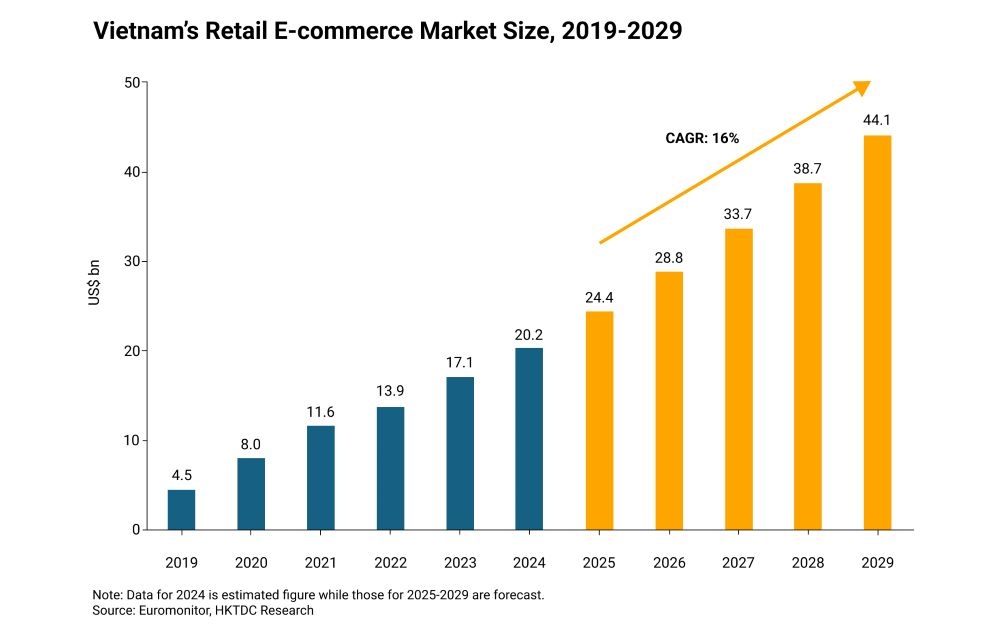
Vietnam’s retail e-commerce market is expected to grow by an average annual rate of 16% between 2025 and 2029.
-
Consumers in Vietnam are frequent online shoppers, making an average of 9.2 purchases per month.
-
Consumer electronics (88%), fashion (69%), and cosmetics and personal care products (69%) were the top-selling categories in Vietnam in the past 12 months.
-
Product quality is the most important consideration for Vietnam’s online shoppers. Brand image, price promotion campaigns and product safety are also important factors to be considered.
-
When buying new products or brands, e-consumers in Vietnam care most about brand image, word of mouth or reputation (55%), followed by the presence of unique product features or functions (46%) and value for money (43%).
-
Respondents expressed a preference for foreign brands in six out of 12 product categories, covering luxury goods, cosmetics and personal care, non-prescription medicines and healthcare supplements, sports-related items, baby and children’s products, and consumer electronics.
-
During major festivals, 98% of respondents reported they would spend more, with the increase in spending averaging 28%.
-
Shopee (with which 90% of respondents shopped) and Lazada (77%) are the two leading e-commerce platforms in Vietnam.
-
A large variety of products (19%), promotional campaigns (12%), and the presence of leading brands and reputable merchants (12%) are the top reasons for e-consumers in Vietnam to shop on e-commerce platforms.
-
Reviews and ratings on e-commerce platforms were deemed the most important information source for online shoppers in Vietnam looking for product information (62%), followed by social media platforms (51%) and recommendation by family, relatives or friends (42%).
-
9% of online shoppers in Vietnam expect same-day delivery, with another 32% of them expecting delivery the next day.
Shoppers in Vietnam hold strong recognition and trust on Hong Kong brands
-
Hong Kong brands or products are popular among e-consumers in Vietnam, with 68% of online shoppers having purchased a Hong Kong-sourced product in the past 12 months. Consumers aged 18-29 had a higher tendency to buy Hong Kong products than other age cohorts.
-
E-consumers in Vietnam see Hong Kong products as effectively blending Chinese and Western elements (35%), offering better safety standards (34%) and being authentic (32%).
-
Hong Kong brands and products that e-consumers in Vietnam reported purchasing most often were consumer electronics (77%) followed by fashion (36%), and cosmetics and personal care products (35%).
-
E-consumers in Vietnam show a strong preference for Hong Kong-branded cosmetics and personal care products, as they are willing to spend extra (about 12%) compared with similar products from elsewhere.
Advice for Hong Kong online sellers exploring opportunities in Vietnam
-
As a supplement to the above survey, HKTDC Research conducted a series of interviews with businesses that are currently selling their products to ASEAN consumers through online channels.1
-
According to one cosmetics company, consumers in Vietnam tend to have similar tastes as their Chinese counterparts in areas such as colour choice and a preference for skin‑whitening products. Vietnam was the starting point for his company to explore ASEAN e-commerce market.2
-
The interviewee also highlighted the importance of balancing pricing and brand image in the country’s competitive e-commerce market. To address this, he noted that his company adheres to a four‑tier pricing strategy for its products – a retail price, a promotion price, a deeper discount price and a “shopping festival price” during festival periods and “double-digit” dates campaigns.
The survey reveals distinct consumer preferences among online shoppers in Vietnam, offering actionable insights for strategic planning. These findings underscore the opportunity for Hong Kong‑based companies and brands to leverage their competitive positioning and expand into the growing e‑commerce markets of Vietnam and the broader ASEAN region.
I. Vietnam retail e-commerce market overview
Vietnam’s retail e-commerce market is expected to expand by 16% annually
The value of Vietnam’s retail e‑commerce market in 2024 was estimated to be US$20.2 billion. It is expected to grow to US$44.1 billion in 2029 from US$24.4 billion in 2025 (at an average annual growth rate of 16%), according to projections by Euromonitor.
Imported goods in Vietnam are subject to import duties and VAT
Most goods imported into Vietnam are subject to import duties, which vary by product category and typically range from 0% to 40%. Goods valued below VND1 million (US$40) fall under the de minimis threshold and are exempted from import duties. In addition to import duties, a standard Value‑Added Tax (VAT) of 10% applies to most imported goods, but it has been temporarily reduced to 8% until the end of 2026. Additionally, items such as tobacco products, alcohol and vapour products are subject to excise taxes, known as Special Sales Tax (SST).3
De minimis values, sales taxes and import duties in the ASEAN-6
|
Indonesia |
Malaysia |
The |
Singapore |
Thailand |
Vietnam | |
|
De minimis value |
US$3 |
US$110 |
US$180 |
US$310 |
US$40 |
US$40 |
|
Sales taxes |
12% |
10% |
12% |
9% |
7% |
8% |
|
Import Duties4 |
0%-40% |
0%-30% |
0%-40% |
0% |
0%-30% |
0%-40% |
|
Note: Figures as of July 2025. | ||||||
II. Consumer preference and online shopping patterns in Vietnam
Online shopping appeals more strongly to the younger generation
Consumers in Vietnam shopped online an average of 9.2 times per month. Younger cohorts were more frequent online shoppers than older ones. The 18‑29 age group made purchases most often, averaging at 10.3 times per month. Those aged 30‑49 also shopped frequently, with an average of 9.0 times per month. In contrast, consumers aged 50 and above made fewer online purchases, averaging just 8.1 times per month.
|
Age Groups |
Average purchases per month |
|
18-29 |
10.3 |
|
30-49 |
9.0 |
|
50+ |
8.1 |
|
Overall |
9.2 |
|
N= 304. | |
Consumer electronics represent the top-selling category in online retail transactions
Consumer electronics5 (bought by 88% of those surveyed), fashion (69%), and cosmetics and personal care products (69%) are the three most popular categories of product among online shoppers in Vietnam.
|
Online purchases by product category in the past 12 months |
(%) |
|
Consumer electronics |
88 |
|
Fashion (such as clothing, handbags, trendy brands, accessories and shoes, etc) |
69 |
|
Cosmetics and personal care products (such as shampoo, body wash, lotions, etc) |
69 |
|
Household groceries |
64 |
|
Lifestyle products and houseware products |
58 |
|
Sports related products (such as sports equipment, clothing & shoes, etc) |
54 |
|
Fresh and packaged food products |
43 |
|
Toys and hobby items |
34 |
|
Non-prescription medicine and healthcare supplements |
33 |
|
Pet products |
32 |
|
Baby and children’s products |
27 |
|
Luxury goods (such as jewellery, timepieces, etc) |
21 |
|
N =304. Top three ranked choices by respondents are highlighted, with darker highlights indicating a higher-ranking choice. | |
Product quality remains the most critical influence on consumers’ online purchasing behaviour
In seven out of 10 product categories, “product quality or efficacy” emerged as the top factor for consideration, most notably for sporting goods, and lifestyle & houseware products (both cited by 74% of respondents), fashion (62%), toys and hobby items (60%), luxury goods (52%), cosmetics and personal care products (50%), and non‑prescription medicine and healthcare supplements (46%). It also ranked as the second‑ most significant factor influencing purchase decisions for consumer electronics (52%) and pet products (51%).
“Brand image, word of mouth, and reputation” was the leading factor influencing purchases of baby and children’s products (42%). This also ranked as the second‑most important consideration for sporting goods (50%), fashion products and luxury items (both at 46%), toys and hobby items (44%), and non‑prescription medicine and healthcare supplements (34%). Additionally, it was the third‑most influential factor for consumer electronics (48%) and cosmetics and personal care products (40%).
“Price promotion campaigns” emerged as a key consideration, particularly in the purchase of consumer electronics, with 56% of respondents identifying it as the most important factor. It also ranked as the second‑most influential driver of purchase decisions among e‑consumers in Vietnam for lifestyle and houseware products (50%), and as the third‑most crucial factor for pet products (47%) and sporting goods (44%).
“Product safety or suitability” was viewed as the most critical factor in purchasing pet products (53%). It also ranked as the second‑most influential consideration for online shopping in baby and children’s products (36%), and third for non‑prescription medicine and healthcare supplements (32%).
“Product ingredients” was seen as a key consideration for online shoppers when purchasing cosmetics and personal care items (42%), non‑prescription medicine and healthcare supplements (32%), and baby and children’s products (26%). “Product design and appearance” was especially important when buying toys and hobby items (36%), fashion products (30%), and baby and children’s products (26%). Lastly, shoppers also placed high value on “product functionality and features” when buying lifestyle and houseware products (38%) and “quality of customer service” for the case of luxury goods (36%).
Major factors considered when purchasing online
| (%) |
Consumer electronics |
Fashion |
Cosmetics & personal care products |
Lifestyle & houseware products |
Sports goods |
Non-prescription medicine & healthcare Supplements |
Toys & hobby items |
Pet goods |
Baby & children’s goods |
Luxury goods |
|
Product quality or efficacy |
52 |
62 |
50 |
74 |
74 |
46 |
60 |
51 |
24 |
52 |
|
Brand image, word of mouth or reputation |
48 |
46 |
40 |
28 |
50 |
34 |
44 |
29 |
42 |
46 |
|
Price promotion campaigns |
56 |
22 |
20 |
50 |
44 |
18 |
26 |
47 |
24 |
24 |
| Product safety or suitability |
n.a. |
n.a. |
28 |
n.a. |
n.a. |
32 |
n.a. |
53 |
36 |
n.a. |
| Product ingredients |
n.a. |
n.a. |
42 |
n.a. |
n.a. |
32 |
n.a. |
n.a. |
26 |
n.a. |
|
Product design or appearance |
18 |
30 |
2 |
16 |
22 |
6 |
36 |
2 |
26 |
26 |
|
Product functionality or features |
38 |
20 |
12 |
38 |
24 |
4 |
12 |
10 |
10 |
20 |
|
Customer services quality |
26 |
26 |
16 |
18 |
42 |
22 |
18 |
16 |
24 |
36 |
|
Return and refund policies |
12 |
22 |
10 |
18 |
14 |
16 |
20 |
16 |
20 |
6 |
|
After-sales services |
12 |
10 |
4 |
28 |
4 |
6 |
18 |
16 |
8 |
26 |
|
N = 50 respondents per product category. Note: n.a. means no data is available for the entry. The top three choices ranked by respondents are highlighted, with darker shading indicating a higher-ranking preference. | ||||||||||
Shoppers value brand image most when trying a new product online
When looking to purchase a new product or brand, e‑consumers in Vietnam care most about brand image, word of mouth or reputation (mentioned by 55% of respondents), the presence of unique product features or functions (46%) and value for money (43%).
|
Key factors driving online purchases of a new brand/product |
(%) |
|
Brand - Brand image/ word of mouth/ reputation |
55 |
|
Product - Unique product features or functions |
46 |
|
Product - Value for money |
43 |
|
Price - Attractive price / promotions |
27 |
|
Product - Appealing product or packaging design |
27 |
|
Promotion - Recommended by friends or family |
20 |
|
Promotion - Positive product reviews or ratings by platforms |
19 |
|
Promotion - Large-scale advertising campaigns (such as bus wraps and billboards) |
13 |
|
Promotion - Free sample trial |
12 |
|
Promotion - Celebrities or KOLs endorsement |
10 |
|
Product - Highly sought-after in overseas markets |
8 |
|
Promotion - Live broadcasting or live streaming |
8 |
|
Promotion - Recommended by experts |
7 |
|
N=304. Top three ranked choices by respondents are highlighted, with darker highlights indicating a higher-ranking choice. | |
E-shoppers tend to choose foreign brands over local ones in specific categories
Respondents expressed preference for foreign brands in six out of 12 product categories, covering luxury goods, cosmetics and personal care, non‑prescription medicines and healthcare supplements, sports‑related items, baby and children’s products, and consumer electronics.
|
Online Purchases by Product Category in the Past 12 Months (%) |
Local Brands (L) |
Foreign Brands (F) |
(F-L) |
|
Luxury goods |
56 |
90 |
+34 |
|
Cosmetics and personal care products |
78 |
90 |
+12 |
|
Non-prescription medicine & healthcare supplements |
68 |
80 |
+12 |
|
Sports related products |
70 |
76 |
+6 |
|
Baby and children’s products |
74 |
78 |
+4 |
|
Consumer electronics |
70 |
74 |
+4 |
|
Pet products |
67 |
67 |
0 |
|
Fashion |
80 |
70 |
-10 |
|
Toys and hobby items |
84 |
72 |
-12 |
|
Household groceries |
80 |
68 |
-12 |
|
Lifestyle and houseware products |
78 |
64 |
-14 |
|
Fresh and packaged food products |
96 |
49 |
-47 |
|
N =304. Top three ranked categories where foreign brands preferred over local brands by respondents are highlighted, with darker highlights indicating a higher-ranking choice. | |||
Almost all respondents reported higher online spending during major festivals
98% of respondents said they spend more during major festivals, with an average increase in spending of 28%.
|
Extra spending during major festivals |
(%) |
|
Yes |
98 |
|
Over 40% increase |
17 |
|
21%-40% increase |
48 |
|
11%-20% increase |
29 |
|
1%-10% increase |
4 |
|
Same as usual |
2 |
|
% increase (mean) |
28 |
|
N=304. Source: HKTDC Survey | |
Shopee, Lazada and TikTok are the most popular platforms for online shopping
Shopee and Lazada are among the leading e‑commerce platforms in Vietnam, each offering a wide variety of products such as electronics, fashion, beauty, and lifestyle items. Shopee stands out with its mobile‑first strategy such as its mobile‑friendly interface, which takes advantage of the country’s high smartphone adoption, while Lazada has been adding fresh products on its platforms and expanding its logistics network to rural areas in order to drive new business.6
TikTok, a renowned social media platform owned by a Chinese technology company, holds the third spot in popularity by combining live video streaming with online shopping, allowing hosts to showcase products and engage with a live audience to drive immediate sales.
Top 10 Platforms Used for Online Purchases in the Past 12 Months
|
Rank |
Platform |
(%) |
|
1 |
Shopee VN |
90 |
|
2 |
Lazada VN |
77 |
|
3 |
TikTok |
66 |
|
4 |
Tiki |
41 |
|
5 |
Bach Hoa Xanh |
38 |
|
6 |
Mobile World |
25 |
|
7 |
Sendo |
24 |
|
8 |
Amazon |
21 |
|
9 |
Cho Tot |
19 |
|
10 |
Official brand websites |
7 |
|
N = 304. | ||
A large variety of products is the key reason people shop on e-commerce platforms
All survey respondents reported that they had purchased through e‑commerce platforms. They cited a large variety of products (19%), promotional campaigns (12%), and the presence of leading brands and reputable merchants (12%) as the top reasons for shopping on e‑commerce platforms.
|
Reasons for Shopping Through E-Commerce Platforms |
(%) |
|
Large variety of products including niche brands or unique items |
19 |
|
Launching promotion campaigns such as offering discount vouchers |
12 |
|
Presence of leading brands and reputable merchants |
12 |
|
Fidelity policy |
10 |
|
Price guarantee such as 90-day price match guarantee |
9 |
|
Product description page is informative |
6 |
|
Customer reward programs such as extra discount and priority purchase |
6 |
|
Platform offering value-added services such as free delivery |
5 |
|
User friendly interface |
5 |
|
The return and refund process is simple and fast |
5 |
|
The live broadcast content on the platform is rich and convincing |
5 |
|
Faster delivery |
4 |
|
Real-time logistic tracking service |
2 |
|
Flexibility in choosing a courier company |
2 |
|
N= 304. Top three ranked choices by respondents are highlighted, with darker highlights indicating a higher-ranking choice. | |
Product authenticity is the main reason shoppers choose official brand sites
70% of the respondents who shopped on official websites said it was because of the guarantee of getting authentic products. Other reasons included getting customized products and services as well as discounts.
|
Reasons for Shopping on a Brand’s Official Website |
(%) |
|
Authentic product |
70 |
|
Offering customized products and services |
10 |
|
Brand website offering discount |
10 |
|
Price match guarantee |
5 |
|
Customer loyalty programmes such as additional discount, priority purchase and cash rebates |
5 |
|
Brand loyalty |
0 |
| Selling at a lower price |
0 |
|
N=20. Figures should be interpreted with caution, given the relatively small sample size (<30). Top three ranked choices by respondents are highlighted, with darker highlights indicating a higher-ranking choice. | |
Online shoppers rely primarily on e-commerce reviews and ratings for product insights
Among e‑consumers in Vietnam, the primary source of product information is reviews and ratings on e‑commerce platforms (mentioned by 62% of respondents), followed by social media channels (51%) and recommendations from family, relatives, or friends (42%).
|
Channels to collect product information |
(%) |
|
Reviews and ratings on e-commerce platform (such as Amazon, Shopee, Lazada) |
62 |
|
Social media platforms (e.g. Facebook and TikTok) |
51 |
|
Recommendation by family, relatives or friends |
42 |
|
Relevant articles on search engines such as Google |
33 |
|
Brand official websites or their official social media accounts |
32 |
|
Recommendations by experts/ KOL |
21 |
|
Staff at retail stores |
14 |
|
Online/ Mobile ads |
13 |
|
Email promotions |
7 |
|
N= 304. Top three ranked choices by respondents are highlighted, with darker highlights indicating a higher-ranking choice. | |
41% of online shoppers expect delivery no later than one day after placing orders
9% of online shoppers in Vietnam expect same‑day delivery, with another 32% expecting delivery the next day. In total, 87% of the respondents expect delivery within three days of making purchases.
|
Expected delivery times |
(%) |
|
To be delivered on the same day |
9 |
|
To be delivered on the next day |
32 |
|
To be delivered on the third day |
46 |
|
To be delivered within a week |
13 |
|
To be delivered in two weeks’ time |
0 |
|
Can accept it to be delivered longer than two weeks |
0 |
|
N=304. | |
III. Hong Kong brands in Vietnam
68% of respondents reported purchasing Hong Kong brands or products in the past year. Among them, individuals aged 18‑29 showed the highest preference, followed by those aged 30‑49, while interest dropped significantly among the 50+ age group.
Purchasing Hong Kong Brands or Products in the Last 12 Months
|
Age Groups |
(%) |
|
18-29 |
82 |
|
30-49 |
69 |
|
50+ |
49 |
|
Overall |
68 |
|
N=304. | |
Among Hong Kong goods, consumer electronics top online purchases
The Hong Kong brands and products that respondents reported purchasing most often were consumer electronics (cited by 77% of survey respondents), fashion (36%) and cosmetics and personal care products (35%).
|
Hong Kong brands/products purchased over the past 12 months |
(%) |
|
Consumer electronics |
77 |
|
Fashion |
36 |
|
Cosmetics and personal care products |
35 |
|
Lifestyle products and houseware products |
26 |
|
Household groceries |
19 |
|
Sports related products |
19 |
|
Toys and hobby items |
17 |
|
Luxury goods |
16 |
|
Non-prescription medicine and healthcare supplements |
16 |
|
Baby and children’s products |
12 |
|
Fresh and packaged food products |
11 |
|
Pet products |
6 |
|
N=207. Top three ranked choices by respondents are highlighted, with darker highlights indicating a higher-ranking choice. | |
E-commerce shoppers view Hong Kong brands as distinguished by their fusion of Chinese and Western elements, superior safety standards and reliable authenticity
When asked about their views on Hong Kong brands or products, 35% of respondents said they blend Chinese and Western elements well, 34% considered them to have better safety standards, and 32% believed they are guaranteed to be authentic.
|
Consumer perceptions of Hong Kong brands/products |
(%) |
|
Hong Kong brands can blend Chinese and Western elements well (such as concepts and technique) |
35 |
|
Hong Kong products/brands have better safety standards |
34 |
|
Hong Kong products/brands/companies are guaranteed to be authentic |
32 |
|
Hong Kong products/brands are of higher quality |
31 |
|
Hong Kong products use better material / more durable |
29 |
|
Hong Kong is the window for purchasing limited editions (such as co-branded models, trendy shoes) |
29 |
|
Hong Kong products/brands are more creative |
25 |
|
Hong Kong products are less costly |
23 |
|
Have stronger confidence in Hong Kong products/brands/enterprises |
22 |
|
Hong Kong brands are more trendy |
22 |
|
Hong Kong is a great place to source rare products (e.g. second-hand cameras) |
19 |
|
N=304. Top three ranked choices by respondents are highlighted, with darker highlights indicating a higher-ranking choice. | |
Online shoppers in Vietnam spend more on Hong Kong cosmetics and personal care products
The difference in the amount that e‑consumers in Vietnam spent on Hong Kong brands rather than on those from elsewhere is particularly marked in cosmetic and personal care products. According to the survey, they spent 12% more on this product category.
|
Median expenditure per purchase (US$) |
All |
HK |
|
Cosmetics and personal care products |
33 |
37 |
|
Luxury goods |
394 |
394 |
|
Consumer electronics |
118 |
55 |
|
Toys and hobby items |
79 |
33 |
|
Fashion |
39 |
30 |
|
Sports related products |
71 |
28 |
|
Fresh and packaged food products |
37 |
28 |
|
Lifestyle and houseware products |
59 |
22 |
|
Non-prescription medicine and healthcare supplements |
20 |
20 |
|
Household groceries |
32 |
20 |
|
Baby and children’s products |
118 |
16 |
|
Pet products |
20 |
12 |
|
All = spending on products from all areas; HK = spending on Hong Kong brands and products. | ||
1 See HKTDC Research (2025) ‑ The ASEAN E-Commerce Marketing Strategies and Tactics: The Experts’ Opinion
2 See HKTDC Research (2025) ‑ Pioneering ASEAN Expansion and Strategic Innovation in the Beauty Industry
3 For example, the tax rate for tobacco products can be as high as 75%, reflecting the government’s intent to discourage smoking due to its health implications. See InCorp Vietnam (2025) – Special Consumption Tax in Vietnam: What Foreign Investors Need to Know
4 Depending on the types of imported goods, import duties can be as high as 150% for products such as spirits and alcohol in some of these countries. Import duties rates listed in the table above typically refer to consumer goods sold via retail e‑commerce.
5 This includes audio & video products, home appliances, computer & related accessories, smartphones, tablets & related accessories, e‑sports products and equipment (such as consoles, accessories and games) and other consumer electronic products and accessories (such as wearable electronic devices, power banks, electronic healthcare devices, etc).
6 See Euromonitor (2025) – Retail E‑commerce in Vietnam







































First, please LoginComment After ~